The problem is that the labs are instructed to create a tissue surface that follow he patient’s soft tissues/gum level. This is incorrect (concave), and fits over the tissue like a saddle, which is uncleansable. This design is easier for the lab and faster for the dentist, but a hygiene nightmare for the patient wearing it.
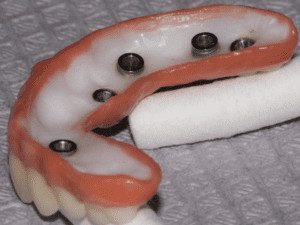
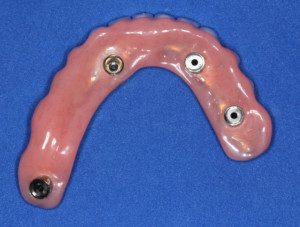
Sorry for the gross photo, but it clearly shows the point:
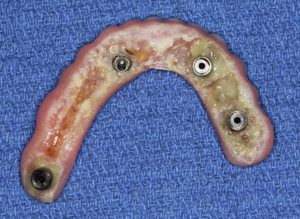
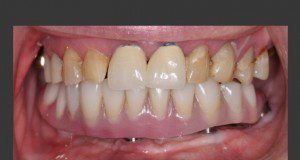
This is what that same patient looks like 3 months after receiving their bridge. The underside of it, being concave, is impossible to cleanse thoroughly using a toothbrush, floss or a Water Pik, because of the finished surface being concave. This patient’s teeth may have LOOKED clean to others when looking at or talking to him because he could brush the outer surfaces, but the underside was impossible to reach. (Resulting in bad taste, breath). Many offices charge a yearly cleaning fee ranging from $250-1,000 per arch (jaw) to remove the prosthesis for cleaning. I wonder if there is a financial incentive for this design?
Remember, this type of prosthesis is screwed into the mouth, onto the implants. So, to allow for thorough cleaning, you need to be able to get the tools you use to clean it – to actually touch all the surfaces you want to clean. So, how do you make a screwed-in prosthesis that is cleansable?
The solution is to make the tissue interface, (where the prosthesis meets the soft tissues) convex (rounded/teardrop shaped) so that brushing and flossing CAN successfully remove the plaque and food debris.
This photo shows the ideally designed underside of a screw retained implant bridge.
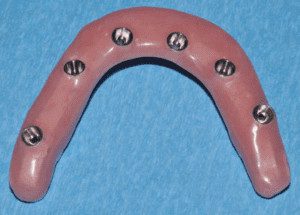
You can see how smooth it is and how, because of the shape, it can easily be cleaned with floss. No more bad taste or bad breath! And, with the proper convex shape, and good patient home care, we rarely need to remove the prosthesis for cleaning by the dentist, thereby saving the patient money every year at recall.
This takes extra time, effort, and lab work. But it IS an attainable goal. This is something many patients don’t learn until AFTER they’ve had one made and designed – the wrong way!
We design our prostheses with this very factor in mind, in fact, Dr. McFadden lectures on this very topic and is one of very few dentists who strongly advocates for this shape. Flossing is an excellent way to remove plaque and debris from underneath these bridges, and with the proper design, it is easily achieved.