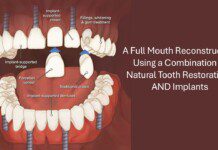
For many patients, All-on-4 is not the best full-arch implant solution. When a patient still has usable bone, favorable anatomy, and the ability to support more ideal implant positioning, an FP1 or FP2 implant bridge is often the more natural, more hygienic, and more prosthetically refined option. All-on-4 was designed to help certain patients avoid more extensive grafting and receive a fixed prosthesis even when bone is limited. That does not mean it should be the default for everyone. Here at The Dental Implant Center, with our approach, the key question is not which protocol is faster or more heavily marketed: The key question is which prosthetic design best preserves bone, supports long-term tissue health, improves cleanability, and gives the patient a restoration that looks and feels closer to natural teeth.
Why All-on-4 is not our preferred approach
Dr. McFadden opposes All-on-4 in most cases because many patients are placed into a denture-style full-arch solution when they may be candidates for a more anatomically ideal fixed bridge design. In many practices, All-on-4 is presented as the only “fixed teeth” option because it is efficient, familiar, and easier to standardize. But efficiency for the provider is not the same as ideal prosthetic design for the patient. When a patient still has substantial bone and does not require a graft-avoidance shortcut, a treatment plan built around more ideal implant positioning and a less bulky prosthesis may better support comfort, esthetics, phonetics, hygiene, and long-term satisfaction. McFadden’s differentiator is not speed. It is comprehensive surgical and prosthetic planning delivered by a dual board-certified specialist, which is exactly the kind of credential-specific authority the McFadden strategy documents say should be surfaced in patient-facing comparison content.
What is All-on-4 actually designed to do?
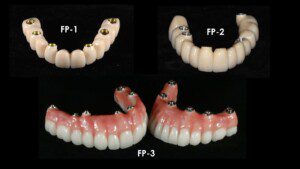
All-on-4 (FP3) is a full-arch implant protocol intended to provide a fixed restoration for patients with total or significant tooth loss and reduced bone volume by using a limited number of implants, often including posterior implants placed at an angle. The original value of All-on-4 is that it can create a fixed-teeth solution for patients who may otherwise need more extensive grafting or different treatment staging. That is why the concept became popular: it can reduce complexity for selected patients and can allow a rapid transition from failing teeth or dentures to a fixed provisional restoration. The problem is not that the protocol exists. The problem is when a graft-avoidance, denture-based design becomes the routine answer even for patients who may qualify for a more individualized bridge design. McFadden’s market analysis also notes that many DFW competitors are volume-focused All-on-4 providers emphasizing standardized protocols and same-day delivery, which supports framing this page as a specialist alternative rather than a generic overview.
How are FP1 and FP2 implant bridges different from All-on-4?
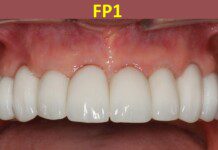
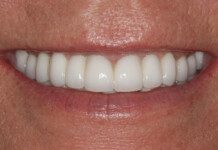
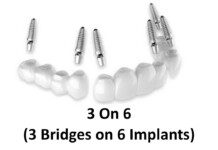
FP1 and FP2 implant bridges are fixed prosthetic designs intended to replace teeth in a way that more closely approximates natural emergence and natural proportions, rather than replacing both the teeth and a large volume of missing gum tissue with a denture-style prosthesis. FP1 and FP2 designs are generally more appropriate when the clinical situation allows the restoration to focus on replacing teeth, not masking lost ridge anatomy with a larger prosthesis. In plain language, that usually means less bulk, less pink prosthetic replacement, and a result that often feels more like real teeth because the restoration is not compensating for as much missing hard and soft tissue. That distinction matters to research-driven patients, because they are not only comparing whether a solution is fixed. They are comparing whether the final result is biologically, functionally, and prosthetically closer to natural dentition.
Why can All-on-4 feel bulky to patients?
All-on-4 often feels bulky because it is frequently a denture-style prosthesis attached to implants, not a tooth-only bridge. When the restoration replaces both teeth and lost soft tissue, the prosthesis usually needs more volume. That bulk can affect speech, tongue space, the way the upper lip is supported, and the patient’s ability to feel that the prosthesis is “their own teeth.” In some cases, clinicians also reduce bone to create restorative space for the prosthesis. For the right patient, that tradeoff may be worth it. For the wrong patient, it can mean sacrificing tissue and anatomy to fit a prosthetic concept that was never the most ideal design in the first place. McFadden’s position is that if a patient has the bone and anatomy to support a less bulky, more natural prosthetic design, treatment planning should begin there rather than defaulting to a denture-replacement concept.
Why does implant angulation matter?
Implant angulation matters because implant position affects load distribution, abutment selection, restorative contours, soft-tissue management, and the long-term cleansability of the prosthesis. When anatomy allows it, more ideal implant positioning can simplify the prosthetic design and reduce the need to compensate for angulation in the final restoration. Greater restorative compensation can create additional prosthetic and hygiene challenges compared with a treatment plan that allows more ideal implant positioning.
Which option is more natural for patients who still have many of their teeth?
For many patients who seek full-arch treatment before all of their teeth are lost, FP1 or FP2 implant bridges may offer the more natural outcome. Patients who still have many teeth and usable bone should not automatically be converted into a denture-style full-arch case. Those patients are often the ones most likely to notice bulk, altered speech, prosthetic flange contours, and the difference between a bridge that replaces teeth versus a prosthesis that replaces both teeth and gums. This is also where Dr. McFadden’s positioning matters most: the McFadden framework emphasizes education, outcome documentation, and comprehensive surgical-prosthetic integration over price competition or volume. He focuses on what makes a “best design for a patient’s given anatomy” rather than a “fastest fixed teeth” approach.
Which option is easier to clean and maintain?
In many well-selected cases, FP1 and FP2 bridges are easier for patients to understand, clean, and live with long term than a bulkier denture-style full-arch prosthesis. Patients do not judge success only by whether the teeth are fixed on the day of surgery. They judge success by how the restoration feels at breakfast, how easily they can clean under it at night, how naturally they speak in meetings, and whether the prosthesis still feels acceptable years later.
When is All-on-4 still a reasonable option?
All-on-4 can still be a reasonable option for selected patients. When a patient has advanced bone loss, is already functioning in a denture-based condition, wants to avoid more extensive grafting, or is not a candidate for a more anatomy-preserving bridge design, All-on-4 (FP3) may be an appropriate solution. It is important though, that the prosthesis be carefully designed with the underside of it being convex, vs. concave, so it does not trap plaque and debris.
How should patients think about All-on-4 vs. FP1/FP2?
| Attribute | All-on-4 | FP1 / FP2 implant bridge |
| Original design purpose | Fixed full-arch option for more compromised anatomy or graft-avoidance scenarios | More anatomy-respecting bridge design when bone and implant positioning allow it |
| Prosthesis type | Often denture-style, replacing teeth and a greater amount of prosthetic gum | Typically focuses more on replacing teeth with less bulk |
| Implant positioning | Often involves restorative compensation for angulated implants | Often allows more ideal implant positioning when anatomy permits |
| Prosthetic feel | Can feel larger or bulkier to some patients | Often feels more natural to the patient |
| Hygiene | Can be harder for some patients to clean under and around | Often simpler to maintain when contours are more natural |
| Bone reduction needs | May require restorative space management that includes bone reduction in some cases | Often better suited to tissue-preserving planning when anatomy is favorable |
| Best candidate | Severe bone loss, denture patient, graft-avoidance case, heavily compromised arch | Patient with remaining teeth, usable bone, and desire for a more natural fixed bridge |
| Practice model fit | Often favored by volume-focused full-arch centers | Better suited to individualized surgical-prosthetic planning |
Which option is right for your situation?
- Choose All-on-4 or FP3 implant bridges when anatomy is limited, graft avoidance is a priority, or a denture-style fixed solution is the most realistic path.
- Choose FP1 or FP2 when you still have enough bone and tissue to support a bridge that is designed to feel, function, and clean more like natural teeth.
- Choose a specialist-led evaluation when you are being told there is only one full-arch option, especially if you still have many of your own teeth.
- Choose comprehensive surgical-prosthetic planning when long-term comfort, hygiene, and natural feel matter more than the fastest path to same-day fixed teeth.
What should patients understand before choosing any full-arch treatment?
A full-arch consultation should not start with a brand name. It should start with anatomy, bone, soft tissue, smile line, phonetics, prosthetic space, hygiene access, and long-term maintenance. The best full-arch treatment is not the one with the most recognizable marketing term. The best full-arch treatment is the one that matches the patient’s anatomy and long-term goals.
If you’re considering full arch or full mouth dental implant treatment, learn about ALL your options. We offer a complimentary consultation (with the doctor, not staff). To call and schedule yours, you can fill out our CONTACT FORM and someone will contact you, or you can call us directly at 214-956-9100.